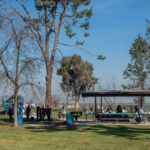
Take a drive into history on scenic Old Stage Road winding through the foothills to the site of Tailholt (now White River), a booming Tulare County Gold Rush town once supporting well over a thousand people (and two cemeteries). Now a peaceful rural hamlet, White River still holds traces of its mining past visible from the road: rock walls and tailings, tunnels, a few old buildings, and those graveyards. Tharp’s Log, the historic single-log cabin of pioneer rancher Hale Tharp, who “discovered” the Giant Forest in 1858, captivates Sequoia National Park visitors who walk the lovely loop trail from Crescent Meadow to Log Meadow where Tharp turned a fire-hollowed fallen giant sequoia into a convenient, weather-proof dwelling. John Muir stayed in it in 1875, and called it a “noble den.” Three Rivers Historical Museum and Visitor’s Center opened in October, 2000, and has been growing ever since, fulfilling its educational and research mission “to preserve the past for future generations” by collecting, preserving, and exhibiting materials relating to our region, and by providing lectures, demonstrations, special events, and participatory programs inviting scholars, residents and visitors to understand and experience our history. Inside are terrific displays, the unique Mineral King Room, and a thoughtful gift shop. Outside: historic structures, vintage vehicles, the 1600′ Heritage Trail, recreated Native American habitations, and Paul Bunyan. The Tulare Assembly Center at the Tulare County Fairgrounds (one of 16 Temporary Detention Camps for Japanese Americans) incarcerated almost 5,000 people in April-September, 1942. Most were then transferred to the hastily built Gila River concentration camp in Arizona and imprisoned there until autumn, 1945. (It was Executive Order 9066, issued in February, 1942, after Japan bombed Pearl Harbor, that a month later stripped of their rights about 120,000 persons of Japanese ancestry — 2/3 of whom were U.S. citizens — on the U. S. West Coast, followed by their forced imprisonment beginning in April.) Inside Visalia’s historic Mooney Grove Park, the Tulare County Museum complex presents a fascinating collection of artifacts from county and California history, an outstanding Native American basketry collection, a trove of memorable agricultural equipment, dozens of restored historic structures, special exhibits, diverse educational programs, a Farm Labor & Agriculture Museum, and an annual Jamboree. The Tulare Historical Museum, “a jewel among the small museums of California,” features an impressively displayed history of the City of Tulare and its heroes; an archives center; the Heritage Art Gallery, which doubles as a community event/reception space; numerous special events and cultural activities; a self-guided audio tour; media displays; and a well-stocked book and gift shop. Built in the Great Depression in 1937 by the PWA, the beautifully-designed Tulare Union High School Auditorium Building is an excellent example of Art Moderne/Streamline Moderne architecture, enhanced with striking interior details that can be enjoyed by attending a public event or visiting by appointment. Take a walk into Tulare’s history, proudly preserved by the community it serves. The original Tule River Indian Reservation in Tulare County was established in 1856 on prime farmland in what is now east Porterville. After California’s Gold Rush began in 1848, thousands of discouraged prospectors began settling instead in the Central Valley to farm its rich soil. Their rapidly increasing population and conversion of the natural landscape caused increasing conflict with the Yokuts-speaking people who had thrived here for thousands of years and were being rapidly dispossessed of their land and livelihood. In 1856, hundreds of the Yokuts were forced onto this “permanent homeland” reservation. Visionary volunteers have been working for years to transform the Tule River corridor through Porterville into a beautiful public park with a 2.2 mile paved trail that leads bikers, birders, botanists, dog-walkers, joggers, gardeners, photographers, picnickers, strollers, and native plant, wildlife, and river lovers through a now-thriving environment including river views and 23 inspiring community gardens. The Tule River Stage Station serving the Butterfield Overland Mail stage route through Tulare County in 1858-1861 was housed on this site (which had been a riverside stopover on the old emigrant trail since 1854). In 1860, Royal Porter Putnam was the station’s keeper. In 1862, a huge flood moved the Tule River’s course south a mile. Convinced that the river would stay in its new course, Putnam bought 40 acres of land around the station’s site, got the parcel surveyed, and laid out the plat of a new town, still called Porterville today In this beautiful sequoia grove, once the site of Hyde’s Mill and popular summer camps, the University of California has been conducting innovative forestry research since 1915. There are no public facilities here, but you can walk an old dirt road and unmarked trails in peace and solitude among the ancient giants of the huge Redwood Mountain grove. (And the Forest Service’s Eshom Creek campground is just a mile down the road.) Tucked into the forest just before Grant Grove Village in Kings Canyon National Park is the historic village of Wilsonia inholding, where, since 1919, Valley residents have built modest cabins in which to live the simple life in the mountains. Listed on the National Register of Historic Places, the majority of the cabins reflect the goals of the owners and the Park Service: to preserve Wilsonia’s rustic, rural character. Fifth generation family members continue Wilsonia’s stewardship and traditions. Visitors from all over the world come to the amazing 13-acre Woodlake Botanical Garden, an oasis of beauty, education, and conservation in Tulare County. The paved 1.2 mile trail leads through thousands of plantings of fruit trees, vegetables, flowers, cacti, row crops, and ornamental trees and shrubs — a feast for all the senses, maintained by dedicated volunteers promoting pride in their community. Includes video. Woodville Park provides the small town of Woodlake with a free, fenced, 10-acre gathering space for residents and visitors of all ages and abilities, offering shaded playground equipment, an arbor, 5 picnic tables with BBQ grills, a soccer field, a 9-hole disc golf course, a baseball diamond with backstop, a basketball court, horseshoe pits, paved pathways, open green spaces, and a restroom. Volunteers tend and add to the grounds (new plants, flagpole, baseball field), and put on events (movie nights, resource fairs, holiday celebrations) keeping the park alive and lively. “Undoubtedly the finest nineteenth century residential structure in Porterville,” the Zalud House, with its elegant Second Empire styling, beautiful garden, art works and keepsakes from around the world, closets full of vintage clothes, family furnishings, superb collection of historic photos, and some say, ghosts, immerses visitors in the scandalous and tragic lives of a prominent family of 100 years agoTAILHOLT

THARP’S LOG

THREE RIVERS HISTORICAL MUSEUM

TULARE ASSEMBLY CENTER

TULARE COUNTY MUSEUM

TULARE HISTORICAL MUSEUM

TULARE UNION HIGH SCHOOL AUDITORIUM

TULE RIVER INDIAN RESERVATION

TULE RIVER PARKWAY

TULE RIVER STAGE STATION

WHITAKER’S FOREST

WILSONIA

WOODLAKE BOTANICAL GARDEN/BRAVO LAKE BOTANICAL GARDEN

WOODVILLE PARK
ZALUD HOUSE MUSEUM