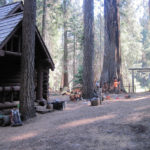
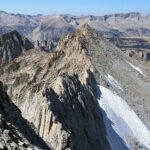
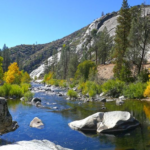
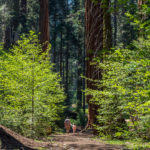
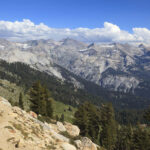
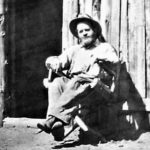
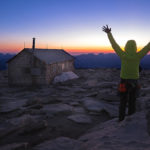
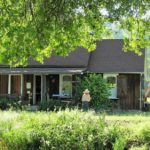
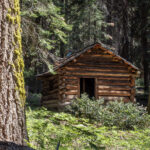
Handsome Redwood Meadow Ranger Station, completed in 1939 by CCC workers, now serving mostly park trail crews, borders not only a wildflower-filled meadow but also a wonderfully remote grove of giant sequoias, offering backpackers and equestrians the rare opportunity to relax, fish, and camp in a lovely Sequoia National Park landscape which they might have almost all to themselves Stretching from the Tule River through oak woodlands to a ridge bordering Giant Sequoia National Monument, River Ridge Ranch & Institute, near Springville, offers birdwatching, camping and lodging, educational activities, fishing, hiking, hunting, nature study, photography, retreats, research and restoration, swimming, and special events on a working ranch with a mission. Includes video. Sacatar Trail Wilderness, truly wild, straddles the Southern Sierra crest in southeastern Tulare County. Protecting highly diverse, almost trackless, pristine landscapes virtually unaltered by human presence, Sacatar invites visitors to experience public lands in their most natural state. Elevations from 3,500′ to 8,800′ host plant life from cactus and desert shrubs through pinyon-juniper woodland to ponderosas and red fir stands with related wildlife. Hikers, backpackers, and peakbaggers who value solitude, discovery, and a sense of the unknown, and are experienced, self-reliant, and well-prepared, will relish time spent in this intriguing, wide-ranging wilderness. In 1958, Clemmie Gill donated 35 acres near Springville to the Tulare County Office of Education, and its SCICON outdoor school of science and conservation was born. Fifth and sixth graders are still learning on SCICON’s now 1,000 acre campus and in its museum, planetarium, observatory, and other facilities, open to the public annually for its BBQ & Wildflower Festival and two Open House events. Hear in the backcountry rangers’ own voices why their job is “a very coveted park position and the one in Sequoia [and Kings Canyon national parks] has got to be one of the best in the nation”; the job is strenuous, challenging, sometimes dangerous, and endlessly rewarding (they get paid in sunsets). Sequoia and Kings Canyon national parks’ trail crews are responsible for creating and maintaining over a thousand miles of trails, working long and arduous days in every kind of weather, often in remote backcountry, at elevations ranging from 2,000 to 14,495 feet. Find out who they are, what they do, and what it takes to get on a trail crew. This job “guarantees an unforgettable experience.” This giant sequoia was brought from Grant Grove in Kings Canyon National Park in 1936, when it was three years old, and planted beside the Visalia Town Center Post Office. A historic treasure, it is also an important reminder of the Central Valley’s vital connection to the Sierra Nevada, source of much of our water supply, as explained in the interpretive features and walkway installed at its base in 2018. Sequoia National Forest’s 1.1 million acres include Giant Sequoia National Monument, 850 miles of trails, 200 miles of Wild and Scenic Rivers, and six Wilderness areas, for endless backpacking, biking, bird watching, boating, botanizing, camping, climbing, fishing, hiking, horseback riding and packing, hunting, kayaking, OHVing, photography, picnicking, whitewater rafting, wildflower and wildlife viewing, and winter and water play opportunities. Sequoia National Park, created in 1890, protects over 400,000 acres, from foothill oak woodlands to Mt. Whitney, highest peak in the contiguous U.S., enticing backpackers, birdwatchers, botanists, campers, cavers, climbers, equestrians, fisher folk, hikers, photographers, picnickers, skiers, and lovers of giant sequoias, geology, wildlife, wildflowers, and history to linger ever longer amidst its treasures. The glorious Sequoia-Kings Canyon Wilderness is huge (over 800,000 acres) and dramatically diverse, with elevations ranging from under 2,000′ to 14,505′ atop Mt. Whitney, threaded by over 800 miles of challenging trails traveling from foothill oak woodlands through varied coniferous forest belts over high passes and along rushing creeks and rivers, through flower-bright meadows, past hundreds of lakes and tarns, into the alpine zone and up to the top of the tallest mountain in the 48 contiguous U.S. states. The scenery is spectacular, the night skies sublime, wildlife abounds, the experience is life-changing, indelible. The Shorty Lovelace Historic District in the high Sierra Nevada of Kings Canyon National Park gives a view into the lifeway, ingenuity, and endurance that Shorty embodied for 40 years as Tulare County’s last true fur-trapping mountain man. Accessible only by foot or stock trail, the sites and remains of his hand-built bare-bones backcountry winter shelters fascinate today’s visitors who learn Shorty’s story. The thousands of hikers summiting 14,505′ Mt. Whitney each year are often amazed, and many times protected, by the 1909 stone and steel Smithsonian Institution Shelter built there with great hardship to enable scientists to survive extreme weather at the top while conducting their astrophysical studies under the stunningly clear starry skies that those hiking the high trail at night can still experience. The wonderfully diverse, readily accessible, family friendly (especially the west side) South Sierra Wilderness includes miles of trails and waterways (highlights: the Pacific Crest National Scenic Trail and the Wild and Scenic South Fork of the Kern River), along with plentiful wildlife, California’s State Fish (the gleaming Golden Trout), long meadows flanked by rolling hills, rocky ridges, and many mountains to climb (elevations run from 6100′ at Kennedy Meadows to 12,000+’ atop Olancha Peak), and forests ranging from pinyon-juniper woodlands to Jeffrey, lodgepole , and red fir higher up. Don’t miss this inviting Wilderness. Located on the rodeo grounds just west of town, the scenic Springville Historical Museum is a wonderful repository of the artifacts and historic records of the upper Tule River region — its early life; its logging, mining, livestock, transportation, and hydropower industries; its important sanitarium; and the beautifully restored, fully furnished pioneer Murphy House crowning its charming outdoor premises. The Squatters Cabin, one of Sequoia National Park’s oldest remaining buildings, is also one of only two known remaining structures of the historic Kaweah Colony (along with the Colony Mill Road, now a hiking trail). The fascinating stories of this ill-fated idealistic, socialistic colony and the founding of our nation’s second great national park are deeply intertwined, centering issues, trends, philosophies, and controversies that are still very much alive today. St. John’s River Trail is a scenic City of Visalia treasure, inviting you to travel up to 4.4 level miles along its namesake river on a paved path suitable for people of all ages and abilities (and dogs, allowed on leash) to walk, hike, run, or wheel along while enjoying the views, reading the interpretive signs, admiring the areas where native trees and smaller plants have been restored, birdwatching, taking a break on a trailside bench, or visiting some of the adjacent parks via their short connecting trails. Early morning and sunset hours are most photogenic. Success Lake, in the scenic Sierra Nevada foothills just 8 miles east of Porterville, formed in 1961 after its huge earth-filled dam was completed by the U.S. Army Corps of Engineers to provide flood risk and water supply management, wildlife habitat, and extensive recreation opportunities including biking, birdwatching, boating, camping, learning at campfire programs and Ranger talks, fishing, hiking, hunting, photography, picnicking, stargazing, swimming, and wildflower and wildlife viewing. Open year-round, the 2,450-acre reservoir and its neighboring 1500-acre wildlife refuge promise visitors of all ages and abilities a great day out in nature. In 2009, Paul and Ruth Buxman traded the development rights on their 40 acre Sweet Home Ranch for a farmland conservation easement, one of Tulare County’s first, securing their prime agricultural land as “Farmland Forever.” Visit these California Clean Growers during their annual two-day harvest festival to savor the produce of local small family farms, wonderful art, crafts, music, and hayride farm tours. REDWOOD MEADOW RANGER STATION
RIVER RIDGE RANCH & INSTITUTE
SACATAR TRAIL WILDERNESS

SCICON
SEQUOIA AND KINGS CANYON NATIONAL PARKS BACKCOUNTRY WILDERNESS RANGERS
SEQUOIA AND KINGS CANYON NATIONAL PARKS TRAIL CREWS

SEQUOIA LEGACY TREE

SEQUOIA NATIONAL FOREST
SEQUOIA NATIONAL PARK
SEQUOIA-KINGS CANYON WILDERNESS
SHORTY LOVELACE HISTORIC DISTRICT
SMITHSONIAN INSTITUTION SHELTER ON MOUNT WHITNEY
SOUTH SIERRA WILDERNESS

SPRINGVILLE HISTORICAL MUSEUM
SQUATTERS CABIN
ST. JOHN’S RIVER TRAIL
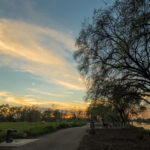
SUCCESS LAKE

SWEET HOME RANCH